
Consumer Agentic Commerce is Ridiculous
The agentic purchasing we actually need is B2B

A few weeks ago, speaking at UBS Napa, I declared that “consumer agentic commerce is ridiculous.” That was admittedly a bit provocative. (I blame the red suit!)
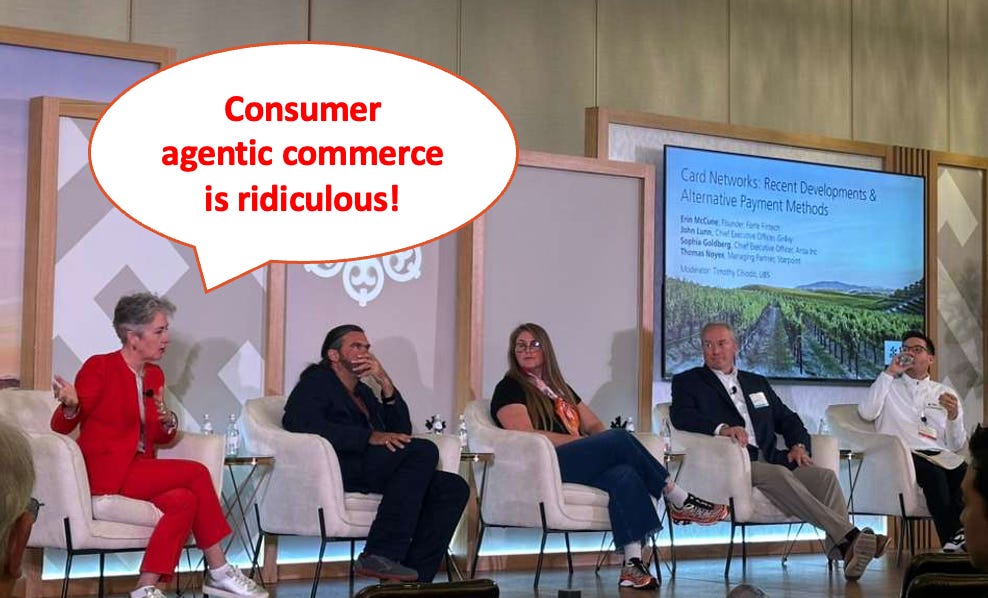
But I stand by my position.
When most people hear the phrase “agentic commerce,” they imagine an AI assistant buying groceries, booking travel, replenishing household supplies, or hunting down the best price online. Consumer purchasing attracts attention because it’s familiar. Everyone understands shopping. Everyone understands the concept of an assistant buying something on their behalf. And it feels plausible because most consumer commerce is already digital and increasingly accessible through APIs that agents can interact with. It’s easy to imagine an agent browsing products, comparing options, and placing an order on your behalf.
The current conversation around agentic commerce tends to focus on payment execution. Which rails will agents use? How will wallets work? Will stablecoins play a role? How should credentials be stored? These are interesting questions, but they may be secondary to a more fundamental concern. As an industry we’re preoccupied with payments and moving money, but the real issue here is delegated authority.
This is where the concept of consumer agentic commerce becomes unrealistic. Consider a seemingly straightforward instruction such as “buy groceries for the week.” It seems straightforward. In reality, it contains dozens of implicit judgments. What’s already in the pantry? Which brands are preferred? How much should be spent? Are substitutions acceptable? Should quality take precedence over price? Does the answer change if guests are coming for dinner? Does anyone in the family have dietary restrictions? What happens if a favored product is unavailable?
Human preferences are highly contextual. We make all kinds of exceptions, change our minds, and struggle to explain why we chose one option over another: taste is highly subjective. The challenge for agentic commerce interpretation is translating vague, evolving human preferences into instructions that software can reliably act upon1. The effort to do so might be worthwhile if consumer purchasing were still burdened by significant friction. But after a decade of digital wallets, stored credentials, tokenization, and embedded payments, checkout is already close to effortless. The efficiency gains from further automation are marginal.
This is one reason why I’m so interested in agentic commerce for B2B.
Every commercial transaction requires employees to determine what can be purchased, from whom, under what circumstances, and with what money (budget associated with a department, product launch, specific project, etc.). As I’ve discussed previously, moving money (the payment) is often the simplest step in the interdependent set of back-office processes.
Purchase orders, approved vendor lists, spending limits, approval hierarchies, contracts, policies, and cost centers all exist for a common purpose: to delegate spending while maintaining control. Businesses have spent decades building frameworks for delegated authority. They were designed for managers, accounts payable clerks, procurement teams, and auditors. But many of the same mechanisms are remarkably well suited to agents.
This is the point I tried to make in a recent essay about the evolution from ledgers to AI. For decades, enterprise software has focused on recording activity after the fact. The emerging opportunity is not simply to record work but to coordinate it. Agents are interesting not because they can initiate a payment. They’re interesting because they may be able to orchestrate the dozens of routine tasks that surround that payment.2
Back-office operations are full of repetitive activities, structured data, established controls, and predictable decision-making. The rules may not always be formally documented. In many organizations, they exist partly as institutional knowledge accumulated over years. Data may be fragmented across ERP systems, procurement platforms, treasury workstations, banking portals, and spreadsheets. Yet the underlying processes are generally stable. Precision and consistency matter more than creativity. Compliance matters more than improvisation.
Those characteristics make these environments unusually attractive for agentic automation.
Trust, which is often cited as the primary barrier to agent adoption, is also more tractable in B2B settings. Commercial relationships are typically ongoing rather than episodic. Counterparties know one another. Contracts exist. Audit requirements exist. Controls exist. Identity frameworks continue to mature. When two companies exchange millions of dollars annually, both sides have incentives to invest in governance mechanisms that reduce risk and improve efficiency.
That is fundamentally different from asking a consumer to trust an agent to make purchasing decisions on their behalf.
Consumers may eventually become comfortable delegating certain categories of decisions to software. The technology will improve, and so will the controls surrounding it. But I suspect the industry’s attention is focused on the most familiar use case rather than the most consequential one. B2B is ripe for agentic commerce. Let’s make it happen.
A recent Bessemer Venture Partners article titled The Rise of the Delegated Buyer lays out the emerging infrastructure stack for consumer agentic commerce. Their central observation that commerce is shifting from active purchasing to delegated purchasing is exactly right. Where I differ is on where delegated purchasing will gain traction first, and where it will create the most value. (B2B!)
Completely agree with this take!
The problem will become verifying that the agent has the authority to transact on behalf of the business (which business? Is the agent acting on behalf of an employee? How are permissions managed?) which is where KYB and organizational identity will be critical.
Tangential to this argument is that many consumer purchases involve the buyer making a choice, evaluating options not just purchasing on price.
Setting aside comfort and trust, my suspicion is consumer agentic commerce will get share with things like paper towels or dish soap, where what the consumer wants is clearly defined, and price is what makes the sale.
Travel, potentially, since getting a good price is time sensitive, and generally consumers know when they want to travel, what terms they, and which airlines they prefer.
But broad use by consumers? I am highly skeptical. Clicking "buy" is not that hard.