
Will Tokenised Money Transform Wholesale and B2B Payments?
The chapter I wrote last year is out. What did I get right? What did I get wrong?

The Tokenisation of Money from Springer which includes my chapter “Will Tokenised Money Transform Wholesale and B2B Payments?” is FINALLY out. You can find it here.
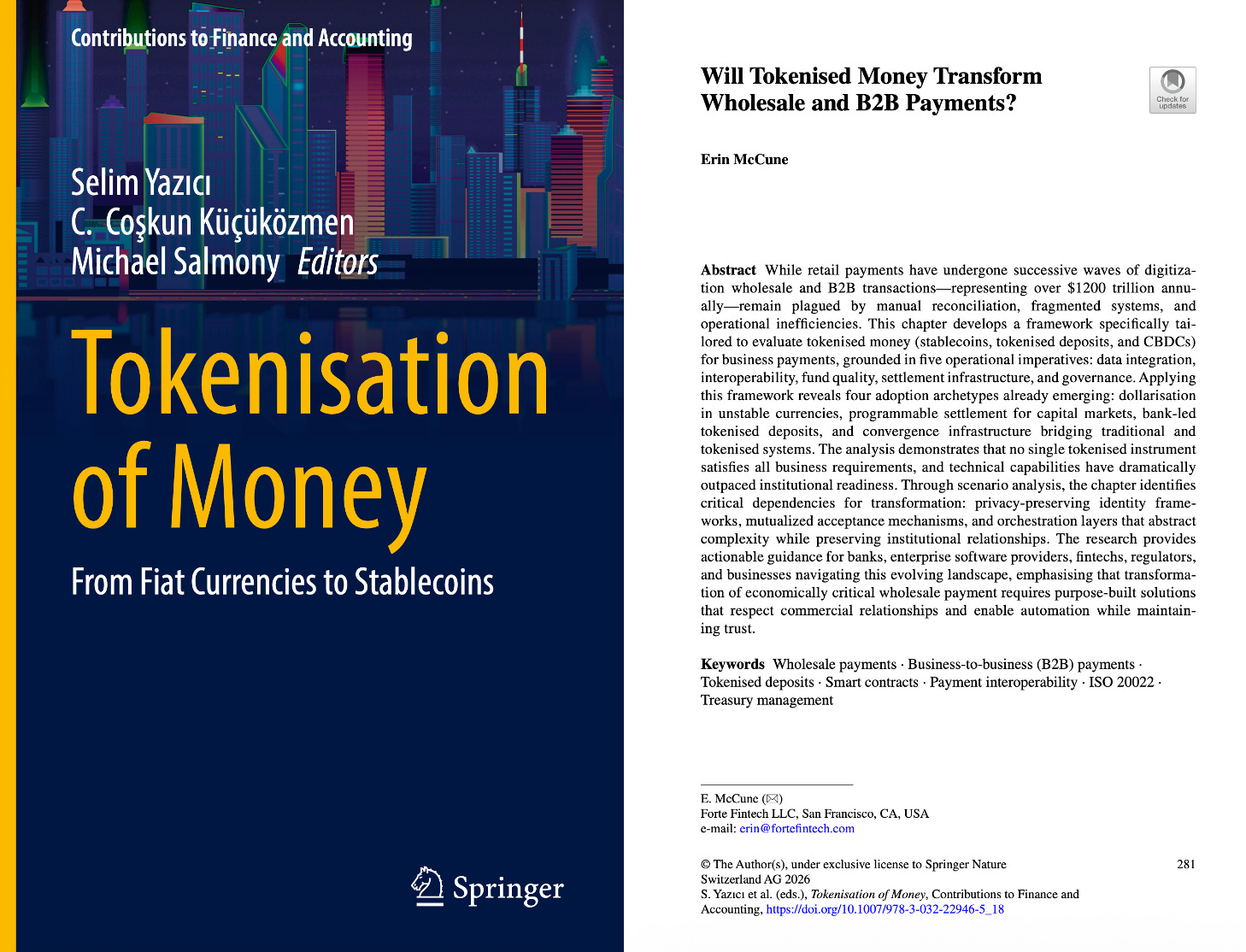
The book had a long gestation: I wrote my piece last August/September. Eleven months is a long time in any field; in payments right now it’s forever!
I knew that anything I wrote would be outdated by the time the book came out, but the rate of change has been even faster than I anticipated.
What’s happened in the meantime
Here are just a few of the things that have happened since I submitted my chapter:
SWIFT finished designing a shared ledger for 40+ banks’ tokenized deposits and started building the MVP, live transactions targeted for year end (Swift).
JPMorgan, BofA, Citi, and Wells turned to The Clearing House to build a tokenized deposit network, targeting early 2027 (press release). Regional banks answered with Cari Network (American Banker). Six UK banks are piloting deposit tokens (UKFinance). Hong Kong is settling them via the HKD RTGS (info.gov.hk).
BIS Project Agorá went from concept to working prototype: 8 central banks, 40+ institutions (BIS, subsequent announcement from the Bank of Canada).
JPMorgan put its deposit token on a Base public chain (JPMC) with multichain expansion via Canton (press release)
Stripe, Coinbase, Mastercard, Visa, BlackRock, and 140 industry players launched OpenUSD, a stablecoin that shares reserve income with participants. Circle’s stock fell 17% that same day (CoinDesk).
Fed Governor Waller floated “skinny” master accounts for payment companies in October 2025 and the concept is in the midst of controversial rulemaking with a goal to be finalized by the end of the year. (Several sources: Fed press release, May 20, 2026, Federal Register NPRM, May 26, 2026, American Banker on the May proposal, DWT on the December prototype, BPI/TCH/FSF joint comment, July 27, 2026, ABA/CBA letter, ICBA concerns, FTA comment letter, Waller’s “middle lane” remarks via ICBA, Mayer Brown on the executive order)
The PBoC rebuilt e-CNY as interest-bearing digital deposit money, a tokenized deposit in all but name (Gov.cn + CIGI commentary by Alex He).
The GENIUS Act moved from statute to rulemaking brawl, primarily over the yield prohibition (Federal Register, BPI et al letter Nov 2025, BPI + CBA comment letter June 2026, Zennon Kapron’s commentary at Forbes),
The NY Fed (revised here), MIT, and BIS-affiliated research evaluate impact stablecoins have on bank deposits. Verdict thus far: substitution at the margin vs. an exodus from TradFi.
Stablecoin growth continues:. Real-economy stablecoin payments run $350–550B a year: big, doubling annually, largest use case is B2B. Also roughly 0.02% of global payments volume. (BCG with Allium, McKinsey with Artemis, and my Skeptical Payment Nerd’s Guide to Evaluating B2B Stablecoin Forecasts here)
Agentic payments went from conference chatter to shipping protocols (Stripe’s ACP, Google’s AP2). But I’d argue (and I have publicly declared) that consumer purchasing is a distraction and the real promise is agentic B2B.
What I wrote last year
The chapter argues that evaluating the relevance of tokenized money for business payments requires B2B-specific criteria. Treasurers aren’t interested in monetary theory: they aren’t debating singleness and elasticity. They want to know whether their suppliers will accept the payment instrument, how their auditor classifies funds (is it cash?), if their sensitive commercial information is secure, and whether there is adequate data to contextualize the payment and reconcile transactions.
I outlined five requirements for tokenized B2B: (1) embedding data with funds, (2) connecting fragmented systems, (3) ensuring widespread counterparty acceptance, (4) enabling predictable settlement, and (5) maintaining trust.
Then I scored stablecoins, tokenized deposits, and CBDCs against the five imperatives for B2B. As you can see from the table below, no single instrument satisfies all of B2B requirements and tokenized deposits beat stablecoins on four of the five. Today most industry voices reach the opposite conclusion, because they evaluate deposit tokens through a crypto lens (no yield, less trading utility) instead of a corporate treasury lens (prudential framework, singleness, ISO 20022 alignment).
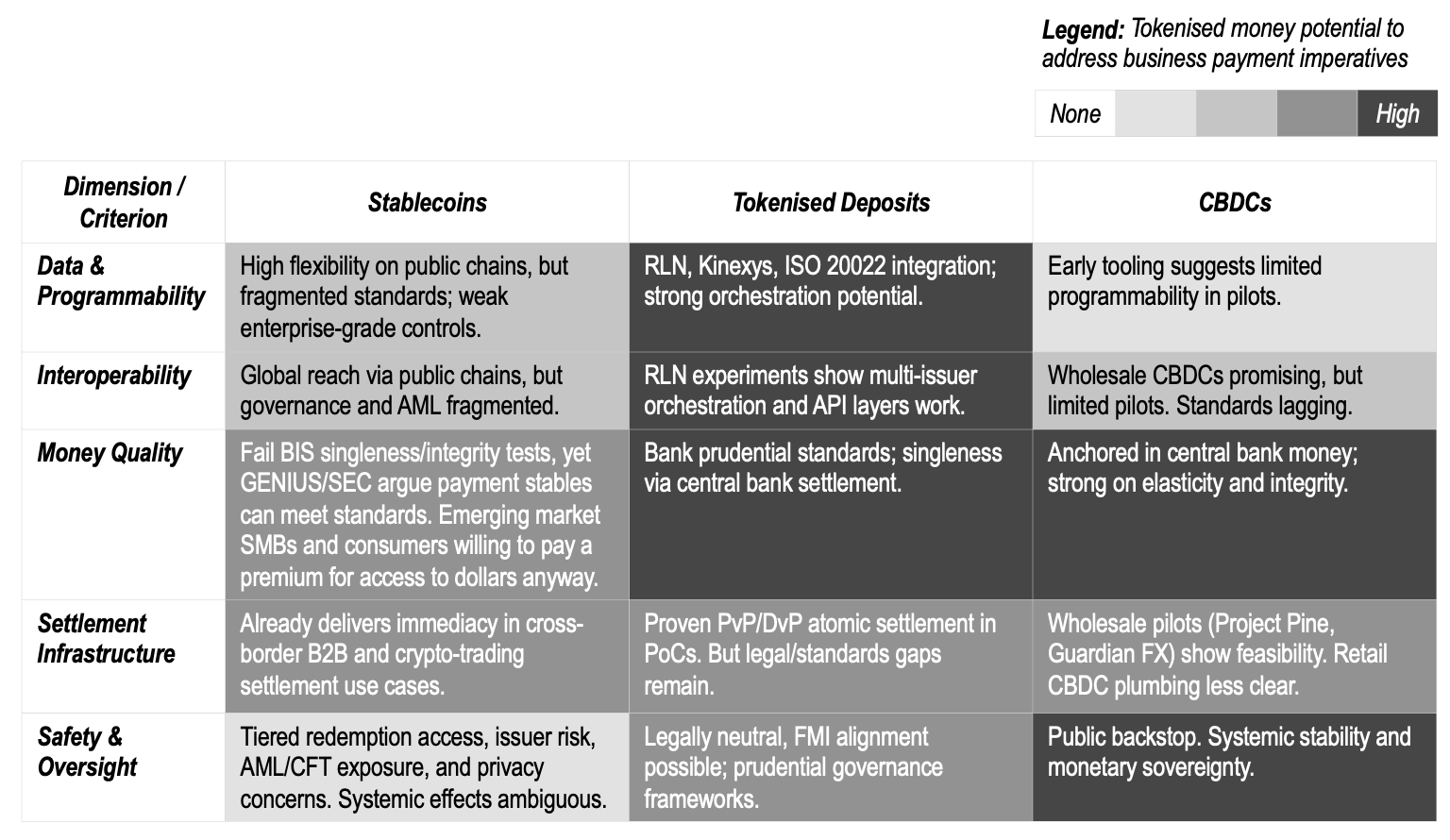
My summer 2025 evaluation of tokenized money
relevance for B2B. Do you agree?
Turning attention to actual adoption, in the chapter I claimed that usage (as of last summer) clusters into four patterns: dollarization in unstable-currency markets, where fund quality swamps every other consideration; programmable settlement in capital markets, where embedded logic pays for itself; bank-issued tokens preserving existing client relationships while adding programmability; and convergence infrastructure (Stripe, Worldpay, the card networks) that makes the new tokenized instrument invisible to the end user yet extending new capabilities on top.
Finally, I dared to make predictions. I put a mere 20% odds against genuine transformation of wholesale payments, 60% on incremental progress concentrated in specific corridors and niches, and 20% that tokenized money would be marginalized in crypto-native uses. My rationale: Genuine transformation requires three elusive things: privacy-preserving identity that’s portable across platforms, mutualized acceptance that solves the many-to-many problem, and orchestration layers connecting tokenised settlement to the ERP and accounting systems where business payments actually begin and end.
Revisiting my framework
Looking at the chapter with fresh eyes nearly a year later, these are my questions:
My list of evaluation criteria. I identified five requirements (I called them imperatives) with data-and-programmability at the top. Is that realistic? We’ve been trying to shove data into payment infrastructure for decades (ISO 20022!). In addition, a reasonable person could argue I’ve bundled too much into “safety and oversight,” so that it is an impossible bar. Or that I’ve elevated reconciliation (a longtime hobbyhorse, of mine) yet there is limited evidence that the market will actually pay for it. If businesses in Lagos and Buenos Aires are happily paying a premium for stablecoins that carry no invoice data or context to tie back to AP and AR, does that requirement really matter?
My scoring. My take: deposit tokens beat stablecoins, for four of five requirements. But a chorus of industry pundits and stablecoin enthusiasts would argue I have this backwards. They haven’t spent as much time as I have in the back office attempting to modernize B2B: my chapter is an invitation to do so! The recent U.S. Big Bank + TCH announcement aligns with my version. But a consortium press release is just that, an announcement, and jaded veterans of bank consortium efforts have every right to be skeptical.
My taxonomy. Are the four archetypes still valid? Are there others? Convergence infrastructure may wind up as distribution rather than an adoption pattern of its own. And my chapter did not anticipate how fast agentic AI would come to dominate payments conversations (albeit with a consumer-, rather than B2B focus). I am increasingly convinced that agentic back office processing and programmatic money movement are inextricably linked.
My prediction. In August 2025 I bet 20% likelihood for true transformation, 60% for incremental improvement, and 20% for marginalization (see table below). A year later, I’m slightly more bullish on transformation, think marginalization is less likely, but believe incremental improvement is still the most likely outcome. Am I deluded?
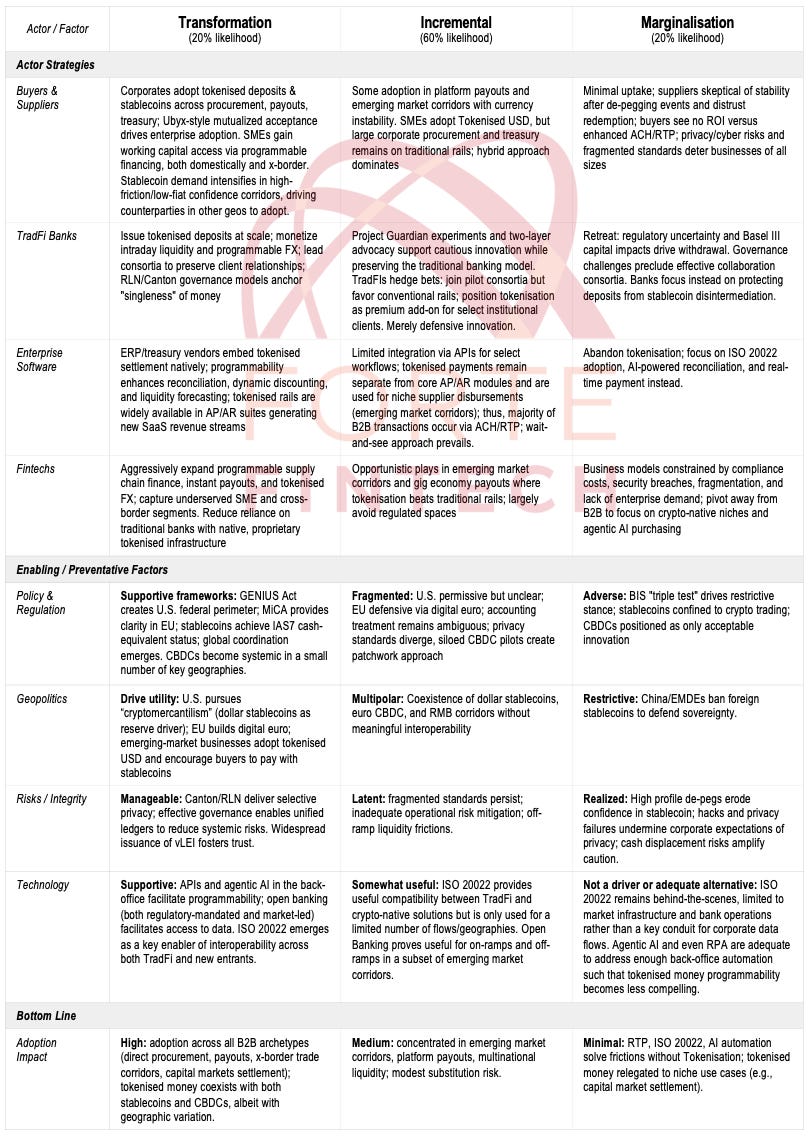
My original predictions + rationale.
I think it holds up - what do you think?
Let’s debate!
Over the next few months my friends at Nyca are hosting a couple roundtables so that I can vet my thinking with my fellow LPAs, I’m proactively reaching out to several of my fellow payment and B2B nerds, and will be publishing a series here on Substack that tests my chapter framework against today’s reality: how much B2B stablecoin volume there really is, what the megabank deposit-token move signals, why we’re still ignoring reconciliation, and yes, whether my 20/60/20 scenario prediction holds up.
As I do so, I’d love to exchange perspectives with you. Argue with me in the comments, reply by email, grab time on my calendar, or write your own rebuttal and send me the link. I’m keen to discuss.